À propos du CEJI (Une Contribution Juive pour une Europe Inclusive)
Le CEJI – Une Contribution Juive pour une Europe Inclusive est organisation européenne créée en 1991, dont la mission est de promouvoir une société inclusive, fondée sur le respect de la diversité, la lutte contre toutes les formes de discrimination et le renforcement de la cohésion sociale. Le CEJI développe une approche transversale qui ne se limite pas à la lutte contre l’antisémitisme, mais s’inscrit dans un engagement plus large contre le racisme, les discours de haine et les préjugés sous toutes leurs formes.
Les activités du CEJI s’articulent principalement autour de la formation, de la sensibilisation et du développement d’outils pédagogiques. L’organisation conçoit et met en œuvre des programmes éducatifs destinés à des publics variés, tels que les enseignants, les travailleurs sociaux, les acteurs de jeunesse, les institutions publiques et les organisations de la société civile. Ces programmes visent à renforcer les compétences en matière de pensée critique, de déconstruction des stéréotypes et de gestion des diversités dans des contextes professionnels et éducatifs.
Le CEJI développe également des méthodologies innovantes, basées notamment sur l’éducation aux droits humains, la psychologie sociale et les pédagogies participatives. Ses outils sont conçus pour favoriser la prise de conscience des biais, encourager le dialogue interculturel et permettre des changements durables dans les attitudes et les pratiques.
Agrément fédéral – Egalité des chances
Dans le cadre de l’agrément fédéral du service Egalité des chances, le CEJI accompagne les professionnels des secteurs de la police, de la santé, de la justice et de la migration, qui jouent un rôle clé dans la garantie des droits fondamentaux et de l’égalité de traitement en Belgique.
Dans ces différents domaines, les professionnels sont confrontés à des situations où les biais implicites, les stéréotypes ou les incompréhensions culturelles peuvent influencer les pratiques, parfois de manière involontaire. Le CEJI propose des formations et des outils visant à renforcer la capacité de ces acteurs à identifier et à déconstruire ces mécanismes afin de garantir des pratiques professionnelles équitables et respectueuses.
Pour la police, les interventions du CEJI peuvent par exemple aider à prévenir le profilage discriminatoire, améliorer les relations entre forces de l’ordre et populations diverses, et renforcer les compétences en gestion de situations sensibles. L’approche privilégie la réflexion critique, l’analyse de cas concrets et le développement de pratiques professionnelles adaptées à des contextes multiculturels.
La méthodologie du CEJI repose sur des approches participatives, issues de l’éducation aux droits humains et de la psychologie sociale. Les formations combinent apports théoriques, mises en situation, études de cas et espaces de dialogue, afin de favoriser une transformation durable des pratiques professionnelles.
Objectifs des activités mises en place dans le cadre de l’agrément
- Informer et sensibiliser les employés de l’administration fédérale belge sur les discriminations courantes (antisémitisme, islamophobie, racisme anti-Noirs, LGBTQIA+phobies) ;
- Former ces employés à mieux comprendre les impacts de ces discriminations sur le bien-être et les droits des citoyens ;
- Promouvoir une culture d’inclusion, de tolérance et de respect dans les divers services publics.
Les activités proposées
- Séances d’information en ligne, à destination des professionnels des secteurs de la police, la justice, la santé et la migration, sur les thématiques suivantes : antisémitisme, islamophobie, racisme anti-Noirs et LGBTQIA+phobies.
- Formations d’une ou deux journées sur les mêmes thématiques, à destination des mêmes publics et des partis politiques.
- Plaidoyer proactif auprès des différents niveaux de pouvoir pour mettre en place des politiques publiques qui promeuvent une société inclusive et apaisée.
- Création de matériaux pédagogiques et de ressources, sous la forme de guides informatifs, pour les professionnels ayant suivi les formations.
Contact
Si vous travaillez dans les secteurs de la police, de la justice, de la santé, de la migration ou dans une administration publique fédérale, vous pouvez nous contacter à ceji@ceji.org.
Set up in 2011 by a group of NGOs led by CEJI – a Jewish Contribution to an Inclusive Europe, Facing Facts is an innovative programme and network aiming to tackle the issue of hate crime and hate speech.
Moving forward, Facing Facts has evolved into a broad international network of civil society organisations and law enforcement agencies that generate holistic, multi-stakeholder approaches to hate crime monitoring, response and prevention.
Vision
Working across communities and institutions to transform understanding of and responses to hate crime and hate speech in Europe and beyond for the benefit of victims, communities and societies.
Mission
The Facing Facts Network works across communities and institutions to transform understandings of and responses to hate crime and hate speech in Europe and beyond for the benefit of victims, communities and EU societies.
Strategic objectives
- To promote victim and outcome-focused practice that increases access to justice, support and safety through: improved reporting, recording, and data collection systems; better and more diverse victim services, and; effective, non-discriminatory investigation and prosecution responses;
- To generate effective and innovative systems-thinking and collaborative responses to the problem of hate crime and hate speech;
- To support transformative national change agents and anti-hate crime and hate speech communities of practice across Europe;
- To develop and ensure access to cutting edge, innovative and collaborative learning and capacity building on hate crime and hate speech, particularly in the online space.
“There are also impressive civil society initiatives to support improved monitoring and investigation of hate speech, such as the ‘Facing Facts’ programme”, Michael O’Flaerty, FRA director at the European Conference on Antisemitism in Vienna in April 2023.
Due to increasing demand for capacity building programmes in this field by EU Member States, the Facing Facts training offer is also available online (www.facingfactsonline.eu) and is used by law enforcement and civil society representatives.
Facing Facts is co-funded by the Citizens, Equality, Rights and Values Programme (2021-2027) of the European Union.

Facing Facts Multimedia Conference. December 11 2018, BRUSSELS BELGIUM.
About the project
The 24-month project “SafeNet: Monitoring and Reporting for Safer Online Environments” seeks to apply a comprehensive and intersectional approach to prevention and fight against intolerance, racism and xenophobia online.
It joins 21 partners, many of them members of the International Network against Cyber Hate (INACH) and the umbrella organisation itself. Many are trusted flaggers and have taken part in the monitoring exercises within the scope of the Code of Conduct on countering illegal hate speech online.
The project tasks will be organised in 3 work packages consisting of management and organisational framework; monitoring of content deemed illegal under national laws transposing the EU Framework Decision 2008/913/JHA using the methodology from the past monitoring exercises conducted by the European Commission; and dissemination of gathered data to the relevant stakeholders and the general public.
Up to 20.000 cases will be reported, 10 infosheets in English and 180 in other EU languages produced, online training run for the monitoring partners, standards for trusted flaggers reached for all partners, advocacy roundtables and a closing conference will be organised.
Objectives
The project focuses on two priorities:
- Continuous monitoring and reporting hate speech content to the IT companies and responsible authorities;
- Awareness raising by regular advocacy towards the social media companies, providing consolidated and interpreted data to national authorities as well as running national bi-monthly information campaigns involving different stakeholders, including IT Companies, public authorities, civil society organisations and media.
The project aims to target online hate based on grounds including but not limited to racial or ethnic origin, colour, religion, sexual orientation or gender identity. One of the objectives is to tackle intersectional forms of hate speech.
Additional target groups involve IT companies, national and European authorities, CSOs and media. The public will benefit from a faster removal of hate speech.
Continuous monitoring
SafeNet’s main goal is continuous monitoring of the IT platforms’ adherence to the Code of Conduct on countering illegal hate speech online. Our consortium will ensure qualitative and continuous monitoring in a period of two years of the IT platforms that are signatories of the Code of Conduct.
In this section, you can find fact sheets in English and national languages, presenting data and drawing conclusions on our monitoring efforts during 10 monitoring periods throughout 24 months.
Fact sheets in English and national languages.
Number of reports on illegal hate speech
Since the start of the project, we have reported 19562 instances of illegal hate speech cases to the IT platforms.
Funded by the European Union. Views and opinions expressed are however those of the author(s) only and do not necessarily reflect those of the European Union. The European Union cannot be held responsible for them. 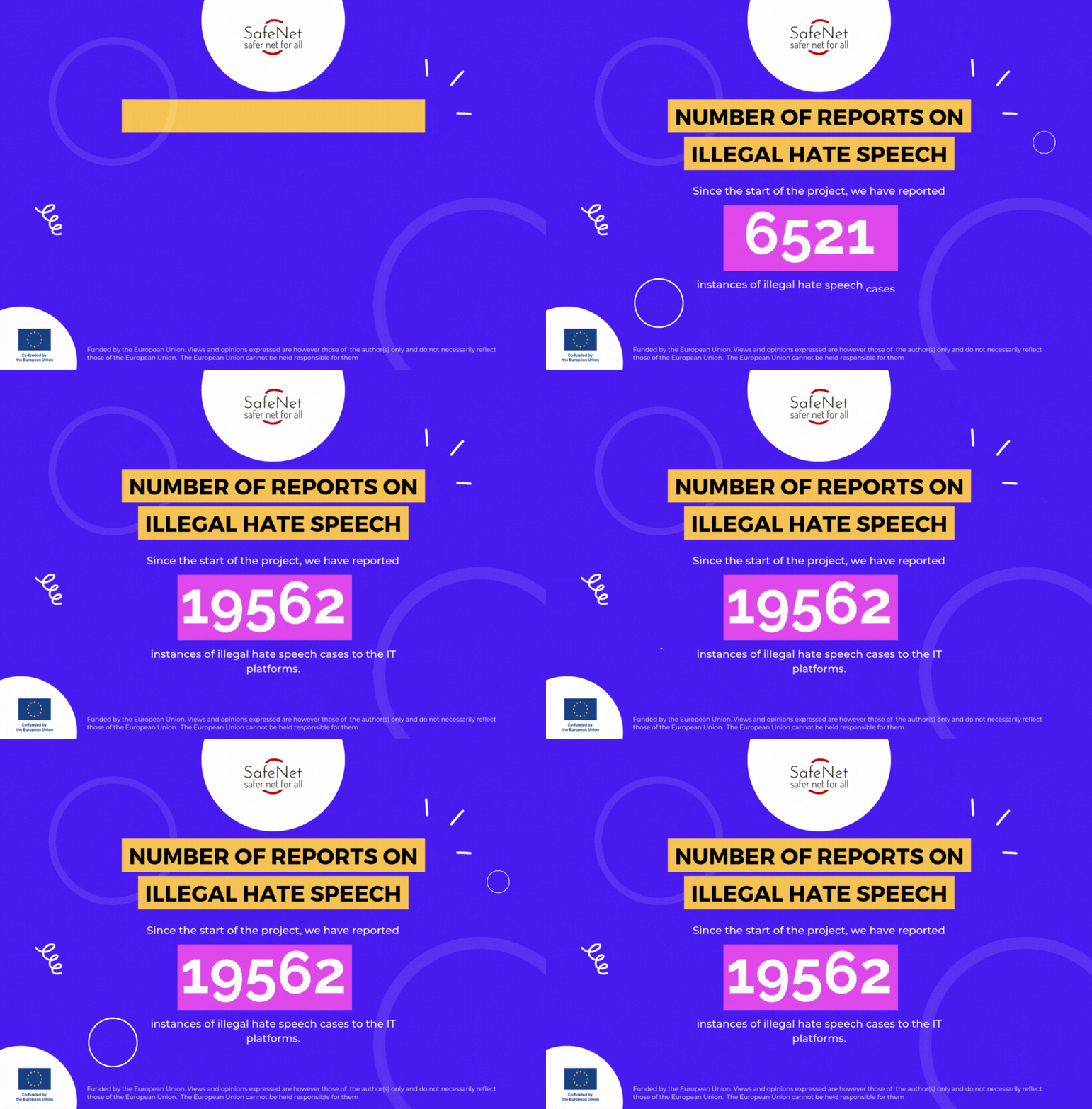
For more information visit the project’s website www.inach.net/safenet/
The main goal of F.A.D.E (Fight Against Antisemitism through training anD awareness raising activitiEs) project is to improve the ability of public authorities in identifying, prosecuting and condemning episodes of discrimination and antisemitic hatred in a timely and effective manner.
The FADE project also intends to:
- Strengthen the support to victims through improving the public awareness of their rights and reporting mechanisms in order to increase the number of reports of antisemitic discrimination and hatred cases,
- Improve the cooperation and information exchange between public authorities and other actors such as civil society organisations in order to achieve a more effective response in combating episodes of discrimination and antisemitic hate,
- Strengthen the data recording and collection systems,
- Develop a training activity for professionals that are in charge of registering and collecting such data.
This project is developed together with the National Office Against Racial Discrimination of the Presidency of the Council of Ministers – UNAR, the Union of Italian Jewish Communities – UCEI, Fondazione Centro di Documentazione Ebraica Contemporanea – CDEC, and Reflect – Research Evaluation Training Technical Assistance S.R.L.
CEJI participates in this project as a leading actor in the development and delivery of online and offline capacity building on antisemitism for police officers, lawyers, prosecutors and judges in Italy.
CEJI is a cooperation partner for the project RE-ACT, Remember and Act, coordinated by INACH, the International Network Against Cyber-Hate.
Analysis of hate data collected by members of the International Network Against Cyber Hate, INACH, in Europe has shown that there are strong and documented links between current online hate phenomena and hate-slurs, prejudices and practices that have been propagated in the Third Reich.
To transform these worrisome findings into effective warnings, especially since remembrance and knowledge on the Holocaust and its horrors are fading, the project Remember and ACT! (Re-ACT) is putting a special focus on researching how “old” concepts of antisemitism and antigypsyism are being re-enacted by concerted hate campaigns and where they originated from. Starting from there, Re-ACT will develop, collect and provide educational materials and tools for the prevention of racism, xenophobia, homophobia and other forms of intolerance.
These self-generated sets of information plus a curated collection of high-quality educational materials will build the foundation for the establishment of an online prevention-hub at INACH.
Project partners are Romea, Licra, Synyo. Additional partnerships with the European Union of Jewish Students, EUJS, and the European Roma Grassroots Organisations Network, ERGO, to allow for even more input to the needs analysis and exchange on a European level and an audience-targeted dissemination of the projects findings and results.
The project is funded by the European Union’s Rights, Equality and Citizenship Programme (2014 – 2020).
CEJI is a partner of the ‘WE CAN for human rights speech’ project, which aims to help organisations and young activists fighting hate speech become more efficient by providing them with user friendly tools and training, which will be developed through evidence-based research. The project will also update the “WE CAN!” manual which was prepared by the No Hate Speech Movement.
The WECAN4HRS is co-ordinated by the Council of Europe with partners as (Active Watch (Romania), APICE (Italy), Neue Deutsche Medienmacher (Germany) and CEJI (Belgium).
The project goals are two-fold:
- To help organisations and young activists fighting hate speech to become more efficient by providing them user friendly tools (developed via evidencebased research and simplified and updated previous materials generated by NHSM) and with trainings
- To consolidate the cooperation among these organisations and activists at the European level and help them in developing new partnerships with social media companies, other networks of NGOs and national authorities.
Throughout the duration of the project, it will:
- Research on how to identify situations most likely to generate waves of hate speech, and on timing and ways of engaging in counter and alternative narratives to have maximum impact. The results will help activists and NGOs be prepared for action and be more effective;
- Develop toolkits and trainings to analyse hate speech, develop human rights-based narratives and communication strategies;
- Organise trainings for trainers;
- Organise thematic seminars on ways to counter some of the most common forms of hate speech, antisemitic, anti-Muslim or anti-Roma discourse.
- Launch and monitor short human rights based narrative campaigns.
WECAN for human rights speech is funded by the European Union’s Rights, Equality and Citizenship Programme (2014-2020) and the Council of Europe.
More information can be found on the project website.
The EU-funded project sCAN – Platforms, Experts, Tools: Specialised Cyber-Activists Network (2018-2020), coordinated by Licra (International League Against Racism and Antisemitism), aims at gathering expertise, tools, methodology and knowledge on cyber hate and developing transnational comprehensive practices for identifying, analysing, reporting and counteracting online hate speech. This project draws on the results of successful European projects already realised, for example the “Research, Report, Remove project: Countering Cyber-Hate phenomena” and “Facing Facts”, and strives to continue, emphasize and strengthen the initiatives developed by the civil society for counteracting hate speech.
Through cross-European cooperation, the project partners will enhance and (further) intensify their fruitful collaboration. The sCAN project partners will contribute to selecting and providing relevant automated monitoring tools to improve the detection of hateful content. Another key aspect of sCAN will be the strengthening of the monitoring actions (e.g. the monitoring exercises) set up by the European Commission . The project partners will also jointly gather knowledge and findings to better identify, explain and understand trends of cyber hate at a transnational level. Furthermore, this project aims to develop cross-European capacity by providing e-learning courses for cyber-activists, moderators and tutors through the Facing Facts Online platform.
sCAN will be implemented by ten different European partners, namely ZARA – Zivilcourage und Anti-Rassismus-Arbeit from Austria, CEJI-A Jewish contribution to an inclusive Europe from Belgium, Human Rights House Zagreb from Croatia, Romea from Czech Republic, Respect Zone from France, jugendschutz.net from Germany, CESIE from Italy, Latvian Centre For Human Rights from Latvia and the University of Ljubljana, Faculty of Social Sciences from Slovenia.
The sCAN project is funded by the European Commission Directorate – General for Justice and Consumers, within the framework of the Rights, Equality and Citizenship (REC) Programme of the European Union.